A vortex ring, also called a toroidal vortex, is a torus-shaped vortex in a fluid or gas; that is, a region where the fluid mostly spins around an imaginary axis line that forms a closed loop. The dominant flow in a vortex ring is said to be toroidal, more precisely poloidal.[clarification needed]

Vortex rings are plentiful in turbulent flows of liquids and gases, but are rarely noticed unless the motion of the fluid is revealed by suspended particles—as in the smoke rings which are often produced intentionally or accidentally by smokers. Fiery vortex rings are also a commonly produced trick by fire eaters. Visible vortex rings can also be formed by the firing of certain artillery, in mushroom clouds, and in microbursts.[1][2]
A vortex ring usually tends to move in a direction that is perpendicular to the plane of the ring and such that the inner edge of the ring moves faster forward than the outer edge. Within a stationary body of fluid, a vortex ring can travel for relatively long distance, carrying the spinning fluid with it.
Structure
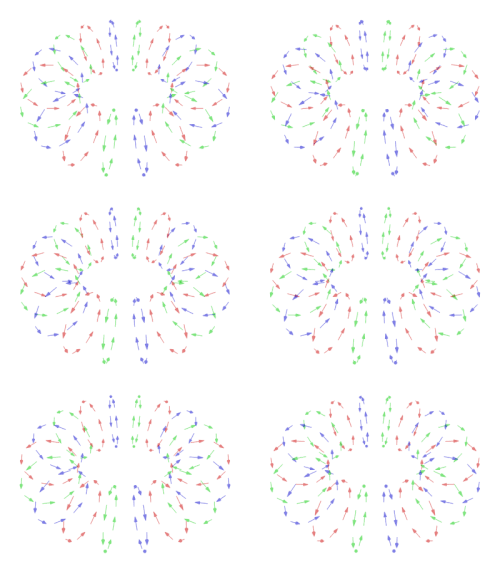
In a typical vortex ring, the fluid particles move in roughly circular paths around an imaginary circle (the core) that is perpendicular to those paths. As in any vortex, the velocity of the fluid is roughly constant except near the core, so that the angular velocity increases towards the core, and most of the vorticity (and hence most of the energy dissipation) is concentrated near it.
Unlike a sea wave, whose motion is only apparent, a moving vortex ring actually carries the spinning fluid along. Just as a rotating wheel lessens friction between a car and the ground, the poloidal flow of the vortex lessens the friction between the core and the surrounding stationary fluid, allowing it to travel a long distance with relatively little loss of mass and kinetic energy, and little change in size or shape. Thus, a vortex ring can carry mass much further and with less dispersion than a jet of fluid. That explains, for instance, why a smoke ring keeps traveling long after any extra smoke blown out with it has stopped and dispersed.[3] These properties of vortex rings are exploited in the vortex ring gun for riot control and vortex ring toys such as the air vortex cannons.[4]
Formation
One way a vortex ring may be formed is by injecting a compact mass of fast moving fluid (A) into a mass of stationary fluid (B) (which may be the same fluid). Viscous friction at the interface between the two fluids slows down the outer layers of A relative to its core. Those outer layers then slip around the mass A and collect at the rear, where they re-enter the mass in the wake of the faster-moving inner part. The net result is a poloidal flow in A that evolves into a vortex ring.
This mechanism is commonly seen, for example, when a drop of colored liquid falls into a cup of water. It is also often seen at the leading edge of a plume or jet of fluid as it enters a stationary mass; the mushroom-like head ("starting plume") that develops at the tip of the jet has a vortex-ring structure.

A variant of this process may occur when a jet within a fluid hits a flat surface, as in a microburst. In this case the poloidal spinning of the vortex ring is due to viscous friction between the layer of fast outward flow near the surface and the slower-moving fluid above it.
A vortex ring is also formed when a mass of fluid is impulsively pushed from an enclosed space through a narrow opening. In this case the poloidal flow is set in motion, at least in part, by interaction between the outer parts of the fluid mass and the edges of the opening. This is how a smoker expels smoke rings from the mouth, and how most vortex ring toys work.
Vortex rings may also be formed in the wake of a solid object that falls or moves through a fluid at sufficient speed. They may form also ahead of an object that abruptly reverses its motion with the fluid, as when producing smoke rings by shaking an incense stick. A vortex ring can also be created by a spinning propeller, as in a blender.
Vortex formation time
Vortex formation time is a concept that was first studied in-vitro by Gharib et al.[5] where the length of the vortex jet (L) was analyzed against small diameter changes (D). What was found is that when the length of the jet divided by the diameter of a fixed outlet was ~4 the vorticity created by the jet optimally contributed to the circulation and size (diameter) of the vortex. Furthermore, when this ratio was below 4 the vortex size and circulation were smaller, and at vortex formation times above 4 the circulation and sizes were comparable to values seen at the optimal value of 4.
So below this optimized index of 4 the vortex ring has room to grow and become optimized and at values above 4 there are only small and diminishing returns. This phenomena of the vortex becoming 'pinched-off' occurs because the velocity of the trailing jet (the shear layer) falls significantly behind the leading vortex and sheds off small vortices.[6]
This index was also observed in nature with lolliguncula brevis squid. Dabiri et al.[7] utilized data from Bartol et al.[8] to analyze how these squid, who use jetting as a form of locomotion to escape predators, form vortices to try and determine if they follow this optimal vortex formation time index of 4 hypothesis. The researchers found that the time averaged formation (time averaged diameters D(t) and time averaged velocities U(t)) then these squid generated jets and vortices with an index between 3.5 and 4.5.
In another study by Gharib et al.[9]the formation time index for vortex rings in the left heart were analyzed to see if the index could assist as an indicator for heart health. 110 volunteers from 5 to 85 years old had their hearts imaged with transthoracic echocardiography without having any prior knowledge of any of the participant's heart health. Using an established normal vortex formation time of between 3.5 and 5.5 the study was able to identify patients with dilated cardiomyopathy because their left heart vortex formation times fell below the normal values seen in patients with healthy hearts.
Other examples
Vortex ring state in helicopters
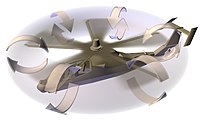
Air vortices can form around the main rotor of a helicopter, causing a dangerous condition known as vortex ring state (VRS) or "settling with power". In this condition, air that moves down through the rotor turns outward, then up, inward, and then down through the rotor again. This re-circulation of flow can negate much of the lifting force and cause a catastrophic loss of altitude. Applying more power (increasing collective pitch) serves to further accelerate the downwash through which the main-rotor is descending, exacerbating the condition.
In the human heart
A vortex ring is formed in the left ventricle of the human heart during cardiac relaxation (diastole), as a jet of blood enters through the mitral valve. This phenomenon was initially observed in vitro[10][11] and subsequently strengthened by analyses based on color Doppler mapping[12][13] and magnetic resonance imaging.[14][15] Some recent studies[16][17] have also confirmed the presence of a vortex ring during rapid filling phase of diastole and implied that the process of vortex ring formation can influence mitral annulus dynamics.
Bubble rings
Releasing air underwater forms bubble rings, which are vortex rings of water with bubbles (or even a single donut-shaped bubble) trapped along its axis line. Such rings are often produced by scuba divers and dolphins.[18]
Separated vortex rings

There has been research and experiments on the existence of separated vortex rings (SVR) such as those formed in the wake of the pappus of a dandelion. This special type of vortex ring effectively stabilizes the seed as it travels through the air and increases the lift generated by the seed.[19][20] Compared to a standard vortex ring, which is propelled downstream, the axially symettric SVR remains attached to the pappus for the duration of its flight and uses drag to enhance the travel.[20][21]
Theory
Historical studies
Vortex rings must have been known for as long as people have been smoking, but a scientific understanding of their nature had to wait for the development of mathematical models of fluid dynamics, such as the Navier-Stokes equations.
Vortex rings were first mathematically analyzed by the German physicist Hermann von Helmholtz, in his 1858 paper On Integrals of the Hydrodynamical Equations which Express Vortex-motion.[22][23][24] The formation, motion and interaction of vortex rings have been extensively studied.[25]
Spherical vortices
For many purposes a ring vortex may be approximated as having a vortex-core of small cross-section. However a simple theoretical solution, called Hill's spherical vortex[26] after the English mathematician Micaiah John Muller Hill (1856–1929), is known in which the vorticity is distributed within a sphere (the internal symmetry of the flow is however still annular). Such a structure or an electromagnetic equivalent has been suggested as an explanation for the internal structure of ball lightning. For example, Shafranov[citation needed] used a magnetohydrodynamic (MHD) analogy to Hill's stationary fluid mechanical vortex to consider the equilibrium conditions of axially symmetric MHD configurations, reducing the problem to the theory of stationary flow of an incompressible fluid. In axial symmetry, he considered general equilibrium for distributed currents and concluded under the Virial Theorem that if there were no gravitation, a bounded equilibrium configuration could exist only in the presence of an azimuthal current.
Instabilities
A kind of azimuthal radiant-symmetric structure was observed by Maxworthy[27] when the vortex ring traveled around a critical velocity, which is between the turbulence and laminar states. Later Huang and Chan[28] reported that if the initial state of the vortex ring is not perfectly circular, another kind of instability would occur. An elliptical vortex ring undergoes an oscillation in which it is first stretched in the vertical direction and squeezed in the horizontal direction, then passes through an intermediate state where it is circular, then is deformed in the opposite way (stretched in the horizontal direction and squeezed in the vertical) before reversing the process and returning to the original state.
| This article uses material from the Wikipedia article Metasyntactic variable, which is released under the Creative Commons Attribution-ShareAlike 3.0 Unported License. |