A moon dog, moondog, or mock moon,[1] (scientific name paraselene,[1] plural paraselenae, meaning "beside the moon") is a relatively rare bright circular spot on a lunar halo caused by the refraction of moonlight by hexagonal-plate-shaped ice crystals in cirrus or cirrostratus clouds.[2]

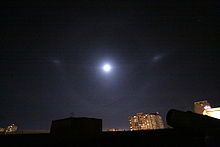
A halo around the Moon and a pair of moon dogs over the observatory at the University of Alberta in Edmonton, Canada.

A pair of moon dogs over Didcot, England
Moon dogs appear as part of the 22° halo, roughly 10 Moon diameters outside the Moon.[3] They are exactly analogous to sun dogs, but are rarer because the Moon must be bright, about quarter moon or more, for the moon dogs to be observed. Moon dogs show little color to the unaided human eye because their light is not bright enough to activate the cone cells.
| This article uses material from the Wikipedia article Metasyntactic variable, which is released under the Creative Commons Attribution-ShareAlike 3.0 Unported License. |