An Earth-grazing fireball (or Earth grazer)[2] is a fireball, a very bright meteor that enters Earth’s atmosphere and leaves again. Some fragments may impact Earth as meteorites, if the meteor starts to break up or explodes in mid-air. These phenomena are then called Earth-grazing meteor processions and bolides.[1] Famous examples of Earth-grazers are the 1972 Great Daylight Fireball and the Meteor Procession of July 20, 1860.[1][3][4]
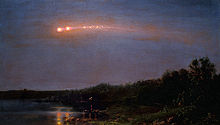
Overview
As an Earth-grazer passes through the atmosphere its mass and velocity are changed, so that its orbit, as it re-enters space, will be different from its orbit as it encountered Earth's atmosphere.[5][6][7]
There is no agreed-upon end to the upper atmosphere, but rather incrementally thinner air from the stratosphere (~50 km), mesosphere (~85 km), and thermosphere (~690 km) up to the exosphere (~10,000) (see also thermopause). For example, a meteoroid can become a meteor at an altitude of 85–120 km above the Earth.
Known Earth-grazing fireballs

An Earth-grazing fireball is a rarely measured kind of fireball[8] caused by a meteoroid that collides with the Earth but survives the collision by passing through, and exiting, the atmosphere. As of 2008 four grazers have been scientifically observed.[9]
- Meteor procession of July 20, 1860[1][3][4]
- Meteor procession of February 9, 1913 led to conclusions a temporary satellite capture of Earth had broken up[10]
- 1972 Great Daylight Fireball, August 10, 1972, US19720810 at 15 km/s above United States and Canada (first scientific observation). It was estimated to have lost about half its mass,[6] and 8 km/s of velocity during the encounter.[5]
- October 13, 1990, a 40 kilogram, 41.5 km/s meteoroid passed at 97.9 km above Czechoslovakia (first orbit calculation based on photographic records from two distant places).[7]
- March 29, 2006, fireball passed 18.8 km/s through the atmosphere 71.4 km above Japan[11][12]
- August 7, 2007, EN070807 passed through the atmosphere over Europe with an orbit belonging to the rare Aten asteroid type[8][13]
- June 10, 2012, an Earth-grazing fireball from the Daytime ζ-Perseid shower passed over Spain, travelling 510 km in the atmosphere. It was the faintest Earth-grazing meteor reported in the scientific literature and the first one belonging to a meteor shower.[14]
- December 24, 2014, a slow moving Christmas Eve fireball SPMN241214 passed over north Africa, Spain, and Portugal, travelling about 1,200 km in the atmosphere.[15]
- July 7, 2017, the Desert Fireball Network observed a grazing fireball that traveled over 1300 km through the atmosphere above Western Australia and South Australia. The closest approach was about 58.5km, and the initial mass is estimated to be a minimum of ~60 kg. The meteoroid came from an Apollo-type orbit, and due to the close encounter with the Earth, it was sent onto a Jupiter-family comet-like orbit.[16]
| This article uses material from the Wikipedia article Metasyntactic variable, which is released under the Creative Commons Attribution-ShareAlike 3.0 Unported License. |